
Gayatri Mantra – An Introduction:
Gayatri Mantra is a very popular and unique mantra that has been discussed, explained & understood by most people. So in this blog I will only briefly touch upon this mantra and concentrate more on the energy aspects of the various elements connected with it.
Santana Dharma or Hinduism is not a religion, it is a state of mind based on an individual’s capability to understand it’s concepts, a perspective towards divinity that is within & around us. There are hundreds of scriptures in Hinduism and a young Sanatani Hindu is often confused as to which scripture he should read to understand this Hindu way of life, whose roots have been lost in antiquity. But among these innumerable scriptures, there are three that stand out and they are the Upanishads, Bhagavad Gita & the Brahma Sutra. These THREE are the Sacred Trinity, also known as Prasthana Trayi – meaning three primary sources of texts.
Upanishads are based on “what is revealed or heard by the ancient Rishis or Shruti” and contains the essence of Vedas, Bhagavad Gita on “what is remembered or Smriti” and Brahma Sutra on “what is reasoned and arrived at through debate, reasoning or Nyaya”and is a blend of both the above scriptures. So these three hold the final say on all scriptural matters and there is no disagreement among scholars on what is stated therein.
The above three books elaborate and analyze “Supreme Reality or Brahman” and the means of realizing it. One needs to understand that Hindu scriptures are steeped in allegory, metaphor, symbolism & mythology. They convey philosophical, spiritual & metaphysical concepts and have very deep universal meanings. So, literal (word for word) translations will only result in understanding the verses incorrectly.
We will now understand the meaning of “mantra” and also the concept of “sound & space”.
What is a Mantra?
Mantra is a word or a set of words that were heard (Shruti) by ancient sages during deep meditation. Constant repetition of a mantra is called “Japa”. The one who chants mantras with utmost sincerity & concentration crosses the endless cycle of birth & death. This is the most important meaning of word – mantra. This involves immense discipline, specific postures & steps and is often lead & supported by a Guru. Essentially, a mantra is word power used for self realization, betterment of self or destruction. In the epics of Ramayana & Mahabharata, we often come across different personalities who have used a mantra which are in effect words infused with energy to launch weapons.
Regular chanting of mantra is called “mantra sadhana” where sadhana means spiritual practice. Sadhana is divided into three main groups: 1) Nitya Karma where a mantra is chanted on a regular or daily basis. 2) Naimittika Karma is when mantras are chanted on special occasions or events (marriage, birth etc) that we come across during our lifetime. In this sadhana, the seeker fixes the number of times the mantra has to be repeated and also the time & period of the chant. 3) Kamya Karma where kamya is derived from the word “kama or desire”, with an intention of achieving a specific desire (begetting wealth or deriving personal benefit).
Out of these Naimittika Karma is of primary importance since under it comes a principle of Purushcharana – a five step procedure to invoke & master the mantra in order to absorb it’s energy. It is essentially a ritualistic practice with an end goal of achieving spiritual liberation or “Moksha” by invoking the divinity within.
The rhythmic sound vibrations of mantras have a positive impact on our central nervous system that controls our thoughts, words & action.
The Vedic concept of Space & Sound:
In my previous blog on Pancha Bhutas or The Five Elements (< click here to know more) I have discussed how sound (shabda) & space (ākāśa) are related. Space is unique, as it has only one “Tanmatra” (Object of Perception) which is Sound! Remaining four elements which are Earth, Fire, Water & Wind (Air) have more than one object of perception. Therefore, Sound is the most subtle object of perception. Space is considered “Supreme Brahman” (< click here to know more) the basic substratum from which the other four elements spring forth. The order of creation begins with space (ākāśa) and from it emerges Air- Fire- Water & finally Earth.
During dissolution of our universe , earth merges into water, water into fire and fire into air, air into space and finally space into the supreme Brahman – consciousness! Thus, space is considered the foremost with sound as its only fundamental quality! Space in modern scientific sense is a living void. ̄̄Ākāśa is a Vedic concept which is roughly equated to space and is considered Supreme Brahman. Chanting of mantras directly impact space through sound vibrations. Indian temple idols are usually sculpted with granite stones that have high resonant frequency which amplify these chants!
When a human desires to speak, he persuades his mind. The mind stirs up the fire or heat element in our navel, which in turn pushes the air which is the carrier of sound. This sound as energy (known as Naada) moves upwards through the spaces in our body (stomach, heart, throat, mouth) as audible sound (known as shabda).
It is necessary to know the mythological story of Sage Vishwamitra, who composed & revealed the Gayatri Mantra. It narrates the rigorous process of purification that Vishwamitra had to go through before merging with the cosmic consciousness or Brahman, thereby becoming a Brahma Rishi.
Rishi Vishwamitra - A warrior King who became a Brahma Rishi:
Only a very brief essence of this well-known story from Indian mythology is narrated in this blog. (pls. watch the video > here < for a more details). King Kaushika was a warrior king (Kshatriya) who ruled the ancient kingdom of Kanyakubja (modern-day Kannauj) in India. As a king, he had a Rajasic temperament, which meant he had ego, desire, greed, jealousy, high passion & energy etc. and was drawn to material pursuits. His life changing experience occurred when he met the Brahma Rishi Vashista at the latter’s hermitage, resulting in a powerful transformation of his self!
Through various cycles transcending thousands of years of rigorous Tapasya (penance), he finally achieved the status a Brahma Rishi (highest among Rishis) and came to be known as Sage Vishwamitra. This story highlights the triumph of potent spiritual power over mundane material gains, letting go of pride, anger, hatred & ego, embracing humility & forgiveness, leading to transformation of self. The one who is contended and wants nothing can manifest anything, but the one who is discontented always struggles in life. This spiritual transformation happens only when our intellect unfolds – this is the main message of the Gayatri Mantra conveyed by Sage Vishwamitra when he “realized” it in his pursuit of Brahman!
Gayatri Mantra:
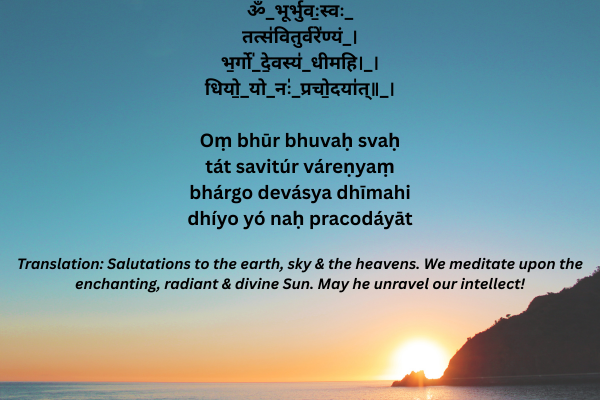
Gayatri Mantra – Explanation:
Om is also called Pranava, a sacred sound symbol, the substratum of our universe – supreme Brahman. Bhūr bhuvaḥ svaḥ are the three worlds that a man experiences during waking (earth or physical plane), dreaming (sky or atmospheric plane) & sleeping (heavenly plane) also known in Sanskrit as prithvi, antarisksha & dyau. These three worlds reminds humans that we are just a minuscule or tiny speck in the huge universe. Realizing this he becomes humble. Tát savitúr váreṇyaṃ, bhárgo devásya dhīmahi – once we realize our modesty, the next step is our intention to bow down and meditate on the divine Sun (Light).
This mantra is a prayer to the Sun (Savitúr) and is also known as “Savitúr mantra”. Since the meter used is the Gayatri meter, it came to be known as Gayatri Mantra. Gayatri meter is a Vedic meter that consists of 24 syllables* presented in three lines (known as “padas or feet”) of eight syllables each. There are different Gayatris’ – for example; Ganesha -Gayatri, Narayana -Gayatri, Mahalakshmi Gayatri, Agni – Gayatri and so on. Dhíyo yó naḥ pracodáyāt – This last line is a final surrender to unravel our intellect and to reveal the supreme self or Brahman that is hidden within us.
* (24 syllables are tat, sa, vi, tur, va, re, ni, yam, bhar, go, de, va, sya, dhi, ma, hi, dhi, yo, yo, na, pra, cho, da, yat)
The earliest mention of Savitur mantra, which later came to be known as Gayatri Mantra, is in Rig Veda 3.62. Verses 10-12 in this Sukta are dedicated to Savitur and credited to Sage Viswamitra. Savitur (Sun) is described as the one who provides light & life and who impacts our intelligence. Due to this magnificence alone, Savitur deserves to be meditated upon & worshiped.
Gayatri Mantra & it's three cosmic divinities of Usha, Savitur & Surya::
We will now look at the three divinities – Usha, Savitur & Surya who are connected with the Savitur Mantra and in the next part about what Brahma Sutras say about the Savitur/ Gayatri mantra.
Usha (Dawn):
When darkness fades away and the first light emerges in the morning, this situation is described as a metaphor in Rig Vedas, as arrival of Usha – a beautiful lady of light! Usha is the light we see before the sun reveals itself. A phenomena caused by scattering of indirect sunlight. She is described as the one who comes in a golden chariot, drawn by horses that represent the rays of the sun. Light particles are photons which are vital for life to be formed. So even before Sun arrives, the first to be invoked is Usha- the first particles of light – the one who inspires!
Dawn happens when the sunlight begins to light up the atmosphere creating a pre-sunrise glow of having different shades of color. Our atmosphere acts as a propagator and therefore Usha is said to make way for the sun to arrive. Usha arises from darkness and arrives like clockwork and goes about her eternal journey. She spurs humans into activity so that they can go about pursuing their purpose in life and is given the honor of a divinity.
Savitur or Savita:
Savita comes from the root word “su” which means to impel or create. While Usha is described as the bride of dawn & Savitur is the groom and used as a metaphor in Rig Veda. Usha emerges first with Savita her partner, as the impeller, a catalyst, divine effulgence, the one who provides life to Surya, the sun. Savita is the cosmic power that stimulates our intellect. Essentially he is the energizer or power behind Usha, the power of both our inner self and outside – the spiritual essence – a life force!
He activates the seven worlds or Lokas which are (Bhu, Bhuvar, Svar, Mahar, Jana, Tapa, and Satya or Brahma Loka) and three primary elements of 1) Surya in heaven 2) Vayu in atmosphere and 3) Agni on earth. He is the face behind the one who is referred to as the golden vessel (surya or sun – as per Isha Upanishad Verse 15)). Savita is therefore none other than supreme Brahman! During post-vedic times, savita has come to be known as surya and vice-versa. But during Rig Vedic times they were viewed differently.
Surya (Sun):
Surya or the Sun is the manifested or visible portion of Savita or Brahman! It is located in heavens and its rays pervades earth & what is in between (atmosphere). A self-luminous light that reveals various forms. Savita in contrast, being Brahman pervades all the regions of heaven, earth including the entire regions of darkness. (Rig Veda 1.35.9).
Our sun is a star! The universe contains billions of galaxies and billions of stars which shine like suns above. So in the Vedas, the sun is not simply viewed as a star but much more as stated in Rig Veda 1.115.1 – The rising morning sun is compared to the face of the Gods and a precious image in the eyes of “Mitra, Varuna & Agni”. It is the soul of the universe as it fills all the three regions in our universe covering our mobile & immobile worlds. It illuminates all but at the same time remains untainted and cannot be contaminated.
The manifested sun is a symbol is supreme consciousness – a pure being and not just a physical star – an observer with a life- vitalizing cosmic eye. Sun is always supported by the two divinities Usha & Savita. To conclude this segment, Usha comes first, driven by the un-manifested Savita and finally Surya manifests – they coexist & work together and are the deities of the Gayatri Mantra!
Gayatri/Savitur mantra is a meditation on Brahman as per Brahma Sutras:
As stated above, surya or the sun has been called an “eye” as it provides light so that we can see. Pure light cannot be seen. Only when light falls on an object we can see it. What we see is gross light which is a blend of three elements – earth, water & light. So after creation happens, we see only mixed light impacted by these three elements. This is the physical portion of light or external. As the Surya or Sun is activated by Savita which is Brahman, it also represents “inner light” that makes us see what is outside.
Savitur or Gayatri mantra represents both unmanifest & manifest and this can happen only if Brahman is referred to in this mantra. Brahma Sutras also say that “Light is Brahman” because of the mention of feet (or caraņa in sanskrit). Chāndogya Upanishad 3.12.6 mentions that all beings are only one-fourth of the Supreme Brahman or Pususha* or consciousness. The other three-fourths which is immortal rest in heaven. The mantra does not refer to physical sunlight, but Brahman. This concept of four feet is explained in great detail in my three part blog on *Pursuha Suktam (< click here for more and read Verse 10.90.3)
Śāṇḍilya Vidyā explained:
Supreme Brahman is summed up in the Śāṇḍilya Vidyā, which provides knowledge on meditating on Brahman and consists of four parts – 1) All beings manifest from the unmanifested Cosmic soul or supreme Brahman. They they exist for a while and they go back to where they came from. 2) Our next life depends on the Karma performed by us in the present life. 3) Brahman is both transcendent (beyond) & immanent (within) – the space outside a person & same as that is within! 4) The end goal of man is to merge with this Supreme Self or Brahman.
Finally, Gayatri is a meter and a meter implies that it is only a poetic structure consisting of syllables, rhythmic patterns in each line (pada). Gayatri/Savitur Mantra is therefore to be understood as a prayer to Brahman, not a mere meter!
A quick note on the Creation Hymn - Nasadiya Sukta:
Nasadiya Suktam (Rig Veda 10.129) narrates a time in our universe where there was no asat or sat, a period of neither non-existence nor existence, where nothing could be perceived, no sky or space (vyoman) or anything beyond it. There was only absolute darkness and nothingness. This is like an interval between the end of one Yuga cycle and the beginning of the next Yuga cycle – a critical time gap before the birth of our universe – a mysterious state where something exists, yet does not exist – a paradox! What existed at this time was uniform & homogeneous cosmic waters (salilam).
Then that “self sustaining being” came into existence through Tapa (heat). Tapa, Tapas or Tapah can be understood in this context as “creative heat” similar to the heat required by seeds to germinate or the heat provided by a hen to hatch its eggs. Then into that self sustaining being came the first seed of thought in the form of “desire” to create and this began the process of self-manifestation. In deep meditation the Rishis (sages) then understood that it is from this unmanifested state that manifestation happens. But then this Suktam ends with a query – who knows? Even Gods & Sages were born only after creation!
So the question of creation of our universe is still a mystery that rests with the Supreme Being – the unmanifested self! Maybe he knows or does not know? Thus, the ending of Nasadiya Sukta is intentionally inconclusive and indicates that creation is beyond the limited understanding of both gods & humans, as human intellect has only limited or finite capabilities.
Understanding “intellect” as per Nasadiya Sukta & Gayatri Mantra:
As discussed in Nasadiya Sukta above, it is thought in the form of desire that starts the process of manifestation. Both desire & thoughts are actually interrelated as one creates the other. Desire can boost thoughts for acquiring an object of our desire which further increases desire, resulting in more thoughts. The only way to control these thoughts are by using our intellect, as it is a higher faculty than the mind. The Nasadiya Sukta uses intellect to try and understand supreme reality and the creation of the universe. At the same time it also concludes that human intellect has certain limitations.
The Gayatri Mantra on the other hand is a prayer to Savitur (Sun) to expand and awaken this very own intellect. Since thoughts & desires are interrelated as stated above, our desires can be brought under control, through intellect. When desires are erased, the supreme self shines forth. This mantra therefore addressed to Savitur or Sun – the divine light or Brahman and chanted twice during sunrise (dawn) & sunset (dusk) – at twilight! Awakening the intellect which can influence thought (located in the mind) and eventually result in realization of the supreme self (Brahman) within us.
Conclusion:
- Gayatri Mantra mentioned in Rig Veda starts with the second line – tát savitúr. The ancient sages invoked the mantra by adding the first line – Oṃ bhūr bhuvaḥ svaḥ, which are the three worlds that are engrossed in constant hectic activity that cause “disruption or disturbances”. They are Ādhibhoutikam – external or worldly disturbance, Ādhyātmikam – disturbance within us (internal), Ādhidaivikam – cosmic disturbance. So the mantra is initiated by first addressing these three disturbances. It also addresses the three states of consciousness – waking, dreaming & sleeping that also correspond to these three worlds.
- Desire is a vibration or frequency. (Vibration is back & forth movement around a center point. Frequency is the number of times this movement happens in cycles per second or Hertz). When we focus on an object of our desire, our thoughts & emotions get aligned to it. Thought is energy and energy is required for manifestation. Our thoughts are also sent as a feedback to the universe.When thoughts are positive, the corresponding energy of vibration is higher. When we harbor negative thoughts, this energy is low.
- Gayatri Mantra’ is a prayer to enhance our intellect to control our desires, thoughts & actions and to reveal the supreme self (Brahman) within us. So it’s transformative energy can be used to go beyond the yearnings or desires of our body & mind. Once this is accomplished , the supreme self or Brahman shines forth from within!
- When the mantra is understood and chanted regularly and for a long period, it’s energy is absorbed in us. This is not a prayer for any miracle to happen or divine intervention from God. Instead, we are stirring up the hidden & dormant energy within us that can eventually lead to our transformation!
Photos of aerial phenomena filmed by me over the period of few years in the night sky are shown below (watch in full screen)